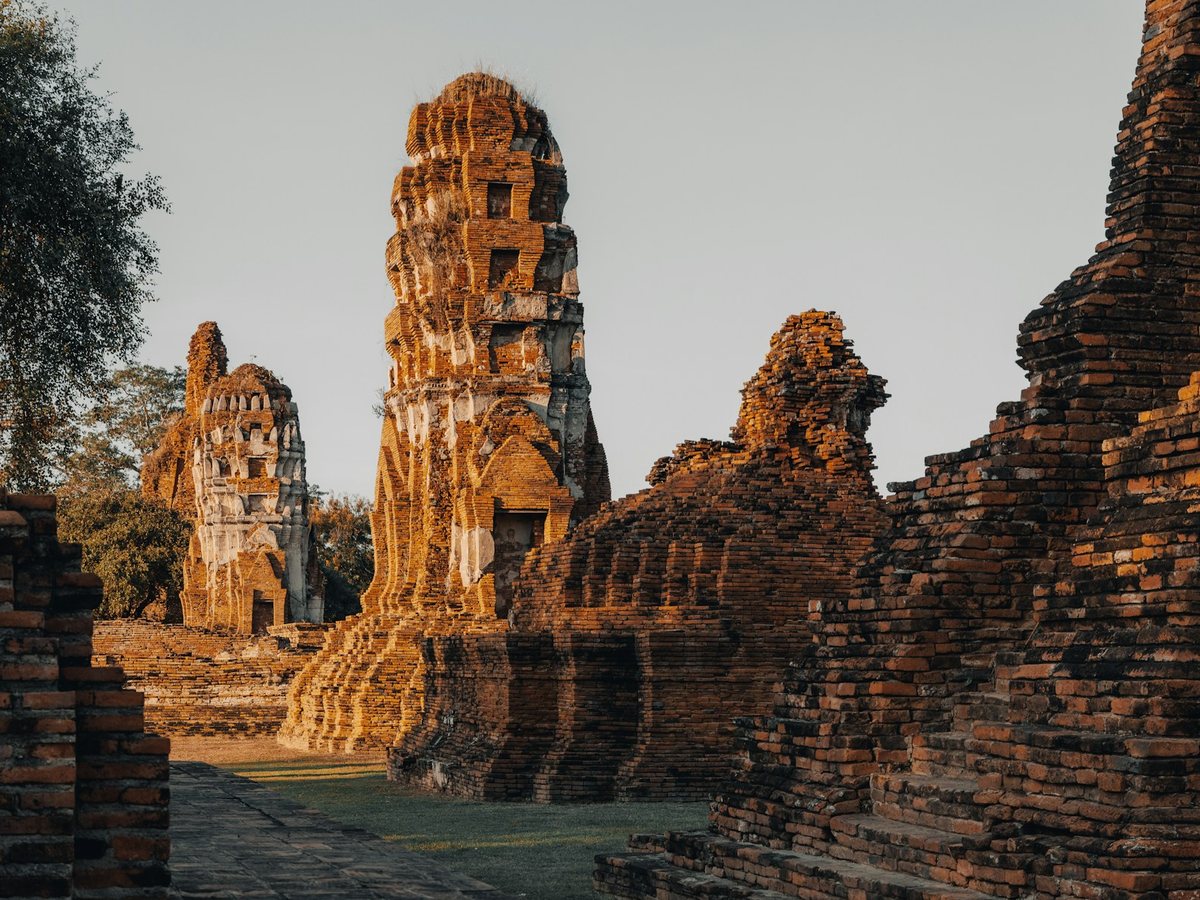
For more than four hundred years, Ayutthaya was the capital of Siam. Foreign visitors in the 1600s compared it to the great cities of Europe. Then, in 1767, a Burmese army burned it, and the capital moved south to where Bangkok is today.
What is left is a field of brick towers and headless Buddhas on an island in the river, about 80 kilometres north of Bangkok. The site is on the UNESCO World Heritage list and an hour away by train. If you only have time for one day trip, we would pick this one.
Is one day enough?
For the highlights, yes. The main temples sit close together on the island, and the two famous ones outside it are a short tuk-tuk ride away. Leave Bangkok around 7 or 8 in the morning and you can be back for dinner.
Stay a night only if you want to see Wat Chaiwatthanaram at sunset without rushing for a train, or if you would like to see the ruins early, before the tour buses arrive from Bangkok.
Getting there
| Option | Time | Cost | Good for |
|---|---|---|---|
| Train from Krung Thep Aphiwat | About 50 to 75 min | From about ฿20 (3rd class) to a few hundred baht (express) | Almost everyone |
| Minivan from Mo Chit | 1.5 to 2.5 hours, depending on traffic | About ฿150 to ฿220 | Hotels near the Northern Bus Terminal |
| Grab or taxi | About 1.5 hours or more | About ฿900 one way with Grab | Groups who want to leave from the hotel |
| Private tour | Door to door | From about $143 per person | No planning, a guide included |
The train is the best option for most people. Most trains to Ayutthaya now leave from Krung Thep Aphiwat Central Terminal (the big new station at Bang Sue, on the MRT Blue Line), and the journey takes about an hour. Fares depend on the train and class: an ordinary third-class seat costs about the same as a coffee, an air-conditioned express seat a few hundred baht. There is also the air-conditioned SRT Bangkok Connex commuter train from Krung Thep Aphiwat, which has cost ฿50 to Ayutthaya since it launched in August 2026. You buy tickets at the station counter. A morning train between 7 and 9 am gets you there before the worst of the heat.
The slow ordinary trains still leave from the old Hua Lamphong station. They are cheap and atmospheric, but take closer to two hours.
Minivans leave from the van terminal at Mo Chit when they are full. On paper they are as fast as the train, but they sit in the same traffic as everyone else, and Mo Chit is a trek from most hotels.
Arriving. Ayutthaya station is on the east bank of the river, and the old city is on the island opposite. Walk straight out of the station and down to the little ferry pier, cross in a few minutes for a few baht, and you are on the island, where the tuk-tuks and bike rentals are.
Getting around
The ruins are spread out, and the sun is serious. You have three choices:
- Tuk-tuk by the hour. The easiest way. Drivers wait at the station and the ferry pier and know the standard temple loop. Expect around ฿200 to ฿300 an hour, or agree a price for half a day. Settle the price and the list of temples before you get in.
- Bicycle. Cheap (around ฿50 a day) and fun on the flat island in the cooler months. Less fun at 1 pm in April. Wat Chaiwatthanaram is across the river and a long ride.
- Walking. Fine for the central three temples, which are within a few minutes of each other. Not for the whole day.
The temples worth your time
There are hundreds of sites in and around Ayutthaya. These five are the ones that make the trip.
Wat Mahathat. The famous one. In the grounds of this ruined monastery, a sandstone Buddha head sits wrapped in the roots of a fig tree. How it got there is not recorded. There is a guard and a sign: crouch or kneel for your photo, so your head is not higher than the Buddha’s.
Wat Ratchaburana. Right across the road from Wat Mahathat, with one of the best-preserved prangs (the tall, corn-cob towers) in Ayutthaya. You can climb partway up and look down into a small crypt where faded murals survive.
Wat Phra Si Sanphet. The royal temple, built on the grounds of the old palace. Its three tall chedis in a row are the classic Ayutthaya picture. No monks lived here; it was used only for royal ceremonies. Next door, Wihan Phra Mongkhon Bophit houses a huge bronze Buddha and is still in use, so it is a good place to see a working temple.
Wat Lokayasutharam. An open field with a reclining Buddha about 40 metres long, out in the open since its hall collapsed. It takes ten minutes and costs nothing. Your tuk-tuk driver will include it.
Wat Chaiwatthanaram. Across the river on the west bank, built by a king in the 1600s in the style of Angkor. It is the most complete of the big temples and the most beautiful in the late-afternoon light. If you only have energy for one more stop at the end of the day, make it this one.
Tickets, hours and what to wear
- Tickets. The historical park itself is free to walk around. The big temples each sell a ticket at the gate (usually ฿50 to ฿80 for foreigners), and there is a combined ticket that covers the main sites. If you are seeing four or more, the combined ticket is usually the better deal. Cash only.
- Hours. The main temples are open daily from about 8 am to 6 pm.
- Dress code. Shoulders and knees covered, for men and women. Light long trousers or a long skirt and a breathable shirt are cooler than they sound, and they keep the sun off. More in our temple dress code guide.
- Bring. Water, sunscreen, a hat and small notes for tickets, the ferry and the tuk-tuk.
A simple one-day plan
- Morning train from Krung Thep Aphiwat, then the ferry to the island.
- Wat Mahathat and Wat Ratchaburana first, while it is still cool.
- Wat Phra Si Sanphet and the big bronze Buddha next door.
- Lunch. Ayutthaya is known for grilled river prawns (goong mae nam), sold by size and not cheap, and for roti sai mai, thin roti wrapped around strands of spun sugar, sold all over town.
- Reclining Buddha, then Wat Chaiwatthanaram in the afternoon.
- Train back to Bangkok in the late afternoon.
With extra time, add Bang Pa-In, the summer palace of the Thai kings, a short way south of Ayutthaya and on the same railway line. Comparing your options? Our day trips from Bangkok guide puts them side by side.
Tour or on your own?
On your own, Ayutthaya is cheap and very doable: the train, a tuk-tuk and a few temple tickets. The catch is that without someone to explain them, the ruins blur into one another after the third temple. You see a lot of beautiful brick and understand very little of it.
A private tour solves both problems. You are picked up at your hotel, driven between the temples, tickets and lunch are paid for, and a licensed guide tells the stories behind what you are looking at.
If you go on your own, a good tip: buy a short guidebook or download a few pages about the temples before you go, and read them on the train. Ten minutes of history makes the whole day better.
Sources: State Railway of Thailand timetables and fares as reported in the Thai press, the Fine Arts Department, UNESCO. Prices checked November 2026.